Showing posts with label thomas kuhn. Show all posts

Wednesday, September 12, 2018

The Power of Paradigms


In the early 1980's I was asked to write the 20th century chapters for a new edition of an American History textbook for Harcourt Brace. The request came from one of my former high school history teachers (who gave me a D+ in his Russian History course--but that is another story) who did not have time to do the writing. My interest was piqued by two things--first, this was the book that was used by cadets at West Point and I would get the chance to write the Vietnam War chapters; in fact, my "audition essay" was about why 1968 would be seen as the pivotal year for a generation of Americans. Second, I had just discovered the concept of shifting paradigms. Thomas Kuhn in his landmark book The Structure of Scientific Revolutions posited that it was the anomalies in science that triggered revolutions which took the form of the creation of entirely new paradigms or "maps" of our world view.  One of his primary examples was the "Copernican Revolution" that overturned the previously held Ptolemaic idea that the earth was at the center of the solar system. But if you have any doubt about how powerful even discredited paradigms can hold on, consider that you probably often check the weather report to see what time the sun is going to "rise" or "set." And, while I confess that as I look out at the sky it does appear to my eyes that the sun is setting or rising, the science just doesn't seem to back up my visual experience.


This idea of a paradigm shift became the rage all over the academic world at this time, and my response to it was no exception. It was pretty clear to me what the "anomalies" were in the way American history was told then in any book:  women, African-Americans, Native Americans, and immigrants (more on that in a bit). Clearly what was needed in order to have the necessary revolution in the telling of American history was a re-imagining of the narrative to overturn the present paradigm.

The reigning paradigm was one that had gained huge traction from Louis Hartz' award-winning book The Liberal Tradition in America (1955) -- "American exceptionalism." Hartz created a story that posited that America was unlike any other country before it, and it had a superior place in world history because it was a special blend of liberty, the frontier experience, democratic republicanism, political liberalism, laissez-faire capitalist economics, and individualism. As a testament to the lasting power of paradigms, this is precisely what we are fighting over every night in 2018 on FOX news and MSNBC. Remember Obama's comment in 2009 about American exceptionalism? In an interview in Europe he responded to a journalist's question, "I believe in American exceptionalism, just as I suspect that the Brits believe in British exceptionalism and the Greeks believe in Greek exceptionalism." He then went on to say, "I see no contradiction between believing that America has a continued extraordinary role in leading the world towards peace and prosperity and recognizing that leadership is incumbent, depends on, our ability to create partnerships because we create partnerships because we can't solve these problems alone." Outrage followed from many circles! James Kirchick called him the Squanderer in Chief in the New Republic. Mitt Romney attacked full frontal in his tome, No Apology: The Case for American Greatness, and you can tune into Sean Hannity or Tucker Carlson almost any night and hear Mike Huckabee repeat what he said then, "He (Obama) grew up more as a globalist than an American," Huckabee said. "To deny American exceptionalism is in essence to deny the heart and soul of this nation." Old paradigms are very powerful. Have you ever noticed that we are the only country in the world with the greatest number of "We're #1" foam fingers (often made in China) that we wave constantly for every possible reason? As I travel the world I fail to see other countries waving these ubiquitous fingers.
Given the civil rights revolution of the late 60's and early 70's, however, it was clear that this paradigm of American exceptionalism did not include large segments of the "anomalous" population in the story. In fact, it was hard to find them in the books at all. In my father's United States History book from the 1920's by renowned Columbia University Professor David Saville Muzzey, all of these people-- women, African-Americans, Native Americans, immigrants and many other groups--are completely absent as the story is one of the relentless progress toward freedom and equality which ends with the American "making the world safe for democracy" in 1919. Muzzey's book (it should be noted that he was a Progressive for his time) was the coin of the realm from 1911 for the next fifty years. The best anyone was doing to change this narrative in the 1980's was putting a little added addendum on such topics as the Trail of Tears at the end of chapters on Andrew Jackson and the Rise of American Democracy or about Manzanar at the end of the World War II chapter about the vanquishing of Hitler and his racist policies. We could not figure out how to actually be Copernicus, we were just doing the equivalent of what Ptolemy did to further his theory by creating a "retrograde motion of Mars" to cover the deep faults. We were essentially re-arranging the deckchairs on the Titanic.

But this was not just a problem for historians. Sociologists used to say that American immigration could be summarized in a non-scatological version of the old bumper sticker that could read, "Assimilation Happens." The theory was that ALL groups will eventually assimilate. Robert Park, a colleague of Booker T. Washington at Tuskegee Institute, developed a widely accepted paradigm for sociology (see illustration of his theory below) at the University of Chicago that paralleled Louis Hartz's consensus view of American political history. However, sociologists have recently been looking at the data and finding anomalies that have challenged Park, and led to concepts such as the "segmented assimilation" of second generation immigrants (especially in New York City) and even to the idea of people developing a "transnational identity" rather than assimilating. New paradigms are just now being developed to explain new data and to question old assumptions. 


Obviously, my book did not pioneer the new paradigm either, but I did get the to explore some new metaphors that might replace the old one of the "melting pot" first created by J. Hector St. John de Crevecoeur in his Letters from an American Farmer in1782.  de Crevecoeur had seen the process of becoming American as the new immigrant "leaving behind him all his ancient prejudices and manners, receives new ones from the new mode of life he has embraced, the government he obeys, and the new rank he holds. He becomes an American by being received in the broad lap of our great Alma Mater. Here individuals of all nations are melted into a new race of men, whose labors and posterity will one day cause great changes in the world." You can clearly see in his thinking part of what will eventually become American exceptionalism. 

Carl Degler saw America as a "salad bowl," New York City mayor David Dinkins as "a grand mosaic," and some people as a "chocolate fondue with various fruits for dipping." John F. Kennedy in his 1958 book A Nation Of Immigrants had also joined the food metaphor club when he wrote, “...a ‘typical American menu’ might include some of the following dishes: ‘Irish stew, chop suey, goulash, chile con carne, ravioli, knockwurst mit sauerkraut, Yorkshire pudding, Welsh rarebit, borscht, gefilte fish, Spanish omelette, caviar, mayonnaise, antipasto, baumkuchen, English muffins, gruyère cheese, Danish pastry, Canadian bacon, hot tamales, wienerschnitzel, petit fours, spumoni, bouillabaisse, mate, scones, Turkish coffee, minestrone, filet mignon.’ ”

Appetizing as many of these new paradigms might be, they do not capture the central paradox of the unofficial motto of the United States, E Pluribus Unum--Out of Many, One." In the next blogpost I want to explore some paradigms that are central to the way we tell our national story and how they have been adopted in schools.

But just to give you a final example of the power of paradigms to shape our thinking, E Pluribus Unum was never the official motto of the United States and it refers not to the inhabitants of the country but to the joining together of the thirteen separate colonies to form one country. The official motto of the United States you can find in your pocket on any piece of currency--In God We Trust. The fact that we put it on our money probably matters as well.

When was that motto adopted?  1956. The year after Louis Hartz's book was published championing American exceptionalism. Always respect the power of paradigms to shape your thinking.

Coda Below: a visual paradigm mash-up of how we constantly create and re-create our own personal and national histories--




Saturday, April 11, 2015

Part Two: Challenge and Support

Earl Weaver was once asked about the essence of the game of baseball. He replied, "A very simple game--you throw the ball, you hit the ball, you catch the ball." But, of course, hitting a baseball has been documented as perhaps the hardest thing to do in sports. There was a time after I had been teaching for awhile when I began to think that teaching could be distilled down to one phrase, "Challenge and Support." But, like Earl Weaver's remark about baseball, while true, that phrase is such an unbelievably hard thing to do in real life and get it right.

When you are engaged in teaching in an experience-based model, however, there are very particular kinds of challenges (and supports) that bring the greatest possible transformation in the learner.  Put most simply, if you can effect a "paradigm shift" in someone's world-view, then you have added a level of learning that will be transformational. If you do it enough times, you may have the good fortune to have that person become someone who deeply understands and can effect their own self-transformation on a repeated basis. In other words, the very act of learning becomes a form of ACTIVISM that the learner uses to effect change in themselves and their world. Sometimes I think of it as service learning on yourself.  If you get interested in the psychology behind this, Bob Kegan has been my go-to person since his book The Evolving Self transformed my own teaching in the early 1980's.
 
But the book that really informed my thinking about paradigms (see the earlier blog post about the paradigm shifts induced by the experience of awe) was one I discovered while teaching a History of Science class:  Thomas Kuhn's The Structure of Scientific Revolutions. Kuhn was the person who had me first seeking out the valuable "anomalies" in my own teaching that would be the key to my own craft evolving.  In addition he got me to realize that if I could effect a "Copernican Revolution" in my student's world view, then I would be creating experience-based learning. So, you may ask, how do
we do this?

Like Copernicus, you first have to have deeply understand the world the way your students (or, in his case, Ptolemy) do. They have mental models of how the world of learning works and you have to know what they know--and HOW they know it. Years ago, I was on a federal government grant team studying "effective teacher behavior." I ended up staking my claim in that study that the number one teacher ability for effectiveness was "cognitive empathy." However, Kierkegaard probably put it best in his journal when he wrote:

"If real success is to attend the effort to bring a person to a definite position, one must first of all take pains to find him where he is and begin there. This is the secret of the art of helping others.... In order to help another effectively I must understand more than he - yet first of all surely I must understand what he understands. If I do not know that, my greater understanding will be of no help to him. Instruction begins when you, the teacher, learn from the learner, put yourself in his place so that you may understand what he understands and in the way he understands it..."

The act of cognitive empathy is perhaps the foundational feature of the experience-based teacher; it is what I think should be the backbone of teacher development. If you understand the world the way your student understands it, then you can design curriculum where the student's model will "fail" or not be sufficient to fit the situation they find themselves in. It is this "expectation failure" then triggers experience-based learning.

This epistemological "split-screen" teaching where you are conscious of not only the content of what is being learned, but also the cognitive skills that are being taught, is what allows the teacher to identify the "mental models" a student is unconsciously using. What I have found so encouraging for the future of experience-based learning is that this kind of thinking/learning/teaching is available to all teachers--those new to the classroom and those with years of experience.


But let me give you two concrete examples--one that effects the student's disposition and one that effects their worldview.

On the first day classes at CITYterm students have read an excerpt about "wondering and wandering" by Harvard professor John Stilgoe. The first day of class is actually a fabulous time to design something based on re-arranging the mental models that students come in with; it is prime time because you will have already established mental models in the students by the end of the first class. CITYterm students arrive having done the reading (maybe the night before) and ready to "discuss" the reading. Some of them are also waiting for an "expectations" sheet to be handed out including plagiarism and grading policies. But after a few minutes identifying the basic concepts of the reading the students and teachers head outside for the rest of the hour to actually DO what Stilgoe is writing about. They literally spend the rest of the hour making increasingly detailed observations about everything on the campus and generating questions and hypotheses about those observations. I know this sounds simple, but it has surprised me how memorable and defining this day becomes for students in their attitude about where learning occurs. What the faculty is trying to do is to have the physically felt experience of what they will do all semester in New York City.

The second example of expectation failure is a bit more complicated but is one of the most powerful Copernican Revolutions (paradigm shifts) that can happen where students learn to read in an experience-based way. (For those of you who follow this blog,  I have discussed this in an earlier blog post about the act of reading.) The other day in class I was telling the story recounted in an earlier post about the author Junot Diaz responding to my query as to where he was on his latest book project--"Oh, yes I am just about done. All I have to do is go back and put in the symbols." However, when I tell students this story virtually none of them ever laugh. In fact, one of them remarked, "that makes a lot of sense because it would be more efficient." That is because his quip fits their mental model of reading as being decoding books for symbols--cue the "green light on the end of Daisy's dock" from The Great Gatsby.

The other mental model that students generally hold is that the author's intention is what solely controls the creation of a piece of fiction. Therefore, they are stunned when an author whose book they are reading tells them that an observation of theirs makes total sense and is very interesting but that "they (the author) did not intend that and had never seen that in the text." Students are befuddled by that until they come to realize that, as the poet Cassie Pruyn writes, "a text is a living beast."
A large part of learning how to read in an experience-based way at CITYterm is designing experiences for students that challenge previously held mental models and force them to create new paradigms for themselves. Many of them, for example, come to a new model that believes that "to read a book is to author it." That shift changes the act of reading for them forever--it is truly Copernican. It also allows them to actively create their own personal understandings of what reading really is. I have found that once you get people comfortable and embracing self-transformation they become enormously creative at it.

There is an enormous amount of creativity and joy that goes into empathizing with students, coming to understand the mental models they hold, and then designing curriculum that forces paradigmatic shifts in thinking. It is when you provide this particular kind of challenge that experience-based learning becomes transformational. It also has the effect of bonding the faculty in wonderful collaborative design efforts that evince and even create a sense of common purpose in what school is supposed to be about--creating students that are their own teachers and teachers who are constantly learning about learning.

But what of support? To be sure, some of the most essential support comes in the form of personal and psycho-emotional awareness of what the student is going through. And there is a great deal written about to be effective in this manner. In the next blog post, however, I will explore what "cognitive supports" might be most helpful in these moments pf paradigmatic, transformational change.

Thursday, July 1, 2010

What you DO with what happens to you


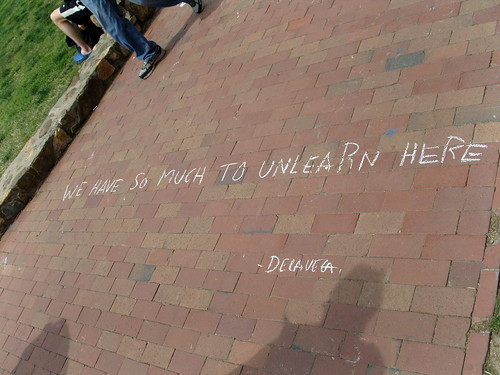
The title of this post comes from a quote by Aldous Huxley taken from his volume, Texts and Pretexts, written in 1932, the same year that he wrote Brave New World. Huxley wrote, “Experience is not what happens to a man; it is what a man does with what happens to him.” Leaving aside for the moment the gendered nature of Huxley’s observation, there is a profound piece of “un-learning” that must be internalized in order to understand what he is talking about—and that seems as good a place as any to start talking about the purpose of this blog. James De La Vega, the East Harlem political activist and philosopher has tried to bring this message of “un-learning” (and many others) to the people of New York City in provocative street graffiti art.
Like the fundamental tension that partially defines New York City, “creative destruction” is a key component to understand in order to understand the nature of experience. Joseph Schumpeter popularized this idea in the 1940’s as an economic concept that related transformation to extreme innovation. But what are the particular innovations you would need in order to effect transformations in your own learning? Creation involves destruction; learning demands un-learning. Shiva, the Hindu god of ambiguity and paradox, is another representation that captures the dynamism of this kind of transformation. Perhaps the very first piece of learning you have to do in order to make what you learn transformative is actually, ironically, an act of un-learning.
My office at school is next to the “learning specialist.” There is a kind of frantic quality to the people who come to her office—they are almost always in some kind of panic. The panic comes, in part, from the fact that they are working from a position of scarcity, they are always short of something, and a feeling of inadequacy permeates their interactions. It is an overwhelming feeling that something is lacking, and something needs to be done about it right away. Urgency and scarcity—those are the feelings that one hears when they walk up to her door. And that is the first thing she has to work really hard to un-do in order to move forward with their learning.
Being an “un-learning specialist” has a different tone to it, not initially, but after you become a steady practitioner. When one is in the throes of unlearning there is a feeling of abundance and plenty. This is, however, not the initial feeling one gets when one is engaged in un-learning. That initial feeling is one of uncertainty and insecurity, as though the world has become a bit unmoored or unhinged. Both of those words evoke a solid feeling—like an anchor or a deep connection. But un-learning produces the opposite effect—adrift and alone. I am reminded of a former headmaster of mine who once told me that his favorite book was Joseph Conrad’s Heart of Darkness and his favorite line from that book was, “We live as we dream—alone.” He had been a former ice hockey goalie in college, and it always appeared to me that feeling of having hockey pucks shot at him at high speed was a metaphor for the way he dealt with his job. Objects came at him fast and furious, and he used any part of his being to deflect them away. He had a remarkable calm which I think came from being alone so much of the time. Goalies in most sports, and certainly in hockey, have a quality of being isolated. In hockey, in particular, there is a masked quality that does not allow you to see anything but the eyes of the goalie. My headmaster had a kind of mask-like quality, inscrutable might be a way to describe it, that was a kind of protection from what was coming at him. And at that school, at that time, he was well advised to put on that mask. Someone once complained that he seemed to be a bit paranoid. Someone else responded buy quoting then National Security Advisor and Secretary of State Henry Kissinger, “If everybody hated you, you’d be paranoid too.” And while it is a massive “guerilla irony” (more on that in a later post) that this line came from the National Security Advisor, it also makes sense in that a sense of isolation can provoke paranoia.
The profound un-learning that must occur is the rejection of the idea that experience is something that happens to us, that we are passive vessels into which life pours experience. But Huxley’s genius is to create a Copernican Revolution, and to change our view of experience from something we receive to something we create. I first came across this idea when I was reading Thomas Kuhn’s book, The Structure of Scientific Revolutions . I was reading this book because I had failed to take any science courses in either high school or college (a long story that I will not recount here), but had realized that I needed to have grounding in scientific thought in order to makes sense of all the history and literature I was teaching and learning. But the operative concept in that book for me was the “paradigm shift.” Copernicus’ replacing of the Ptolemaic geocentric universe with a heliocentric one was the example that Kuhn used to really unhinge my world at the time, and send me into a life-long exploration for assumptions that I held that I was unaware of but accepted primarily because they were un-examined. I remember thinking (or perhaps Kuhn actually wrote this and I have stolen it) that each morning I awoke thinking that the sun had risen, just as I had thought the sun had set the evening before. But all that descriptive language of “sunrise and sunset” was just a holdover from the Ptolemaic universe of epicycles in a planetary model where everything revolved around the earth. How tricky these old models are in the way they inhabit our language and shape the world we live in, I thought. And ever since then I have had an amateur’s fascination with the way our world is constructed by our language.
Purpose. A few years ago, I actually started a workshop session by playing a song from the musical Avenue Q called “Purpose.” The purpose of this blog then is not so much to be the ”flame under your ass” or to be “the car with a full tank of gas, “ but to provide a place where we can explore why certain times become experiences while other times remain as simply events. The former transforms us, and makes life more dynamic and beautiful. However, that exploration is always more exciting when done with other people, regardless of how we dream.
So, here are some initial questions to get us started—what are the most powerful pieces of un-learning that you have had lately, or even not so lately? And, on a larger scale, what are some of things, cognitively and behaviorally, that we DO to make something an experience? How do the events of our lives become transformed into experiences?