Thursday, June 13, 2013

Empathy and Imelda Marcos: A Protocol

Nikki Giovanni has long been one of my favorite poets, and one of many poets and writers whom I am fascinated by how they do what they do. Initially I thought it had something to do with faith and belief--because Nikki Giovanni BELIEVES what she is writing--but then I came across the following quote:

"I resent people who say writers write from
experience.  Writers don’t write from experience,
though many are hesitant to admit that they don’t. I
want to be clear about this.  If you wrote from
experience, you’d get maybe one book, maybe three
poems.  Writers write from empathy."

One of the principles about reading that I have been testing for years is that reading and writing are more intimately connected than people think. Now, I know this is not revolutionary, right? But look at Nikki Giovanni's quote again. If that principle is true, and writers write from empathy, then readers ought to read from empathy. Then, obviously, teachers ought to teach how to read empathically. This is something that I have been talking with teachers about now for a couple of decades, but aside from material on role-playing as a way to increase an empathetic sensibility, I haven't found much.

I had been working on some ideas about "precursors" to empathy (that will perhaps become a later blog post), and then began to see that, for many people, protocols worked well as a harbinger of internalized behavior. Could I develop an "empathy protocol" that I could experiment with on the literature I was teaching this spring?


 At about the time I was implementing this protocol, CITYterm had the chance to see Here Lies Love in the previews stage of production at the Public Theater. This production, put together by musicians David Byrne and Fatboy Slim and directed by Alex Timbers is an immersive theatrical experience that "deconstructs the astonishing journey of First Lady Imelda Marcos from her meteoric rise to power and subsequent descent into infamy and disgrace." While it is an amazing show that has been extended three times, and it was fascinating to watch David Byrne walking around all in white (with matching hair) taking notes throughout, it was the "pre-talk" with Alex Timbers that gave me the most pause to ponder how one creates empathy.

One of the questions that one of the students asked was precisely that--how does an author enter so deeply into Imelda Marcos' head that they could believe they understood her and make the audience believe that as well?

Alex's response (from my cribbed notes) was something like this, "Well, we started by avoiding the obvious cliches of her shoe fetish which might have flattened her; it was too much of a heavy handed symbol and a judgment on her. We were exploring. So one thing that emerged was her love of disco and Studio 54. And the techno-club music became a kind of metaphor for the totalitarian kind of rhythm but also the kind of euphoria of the dance club was the kind of euphoria of being in power."

At this point another student asked, "But how do you know where to start?"

Alex responded, "Well, in this case, we went back to the beginning. To certain assumptions she had about life right from the start. And those assumptions frequently took the form of questions she asked herself--Is it a sin to love too much? Is it a sin to care? and, ultimately, Why don't you love me? That is the question that drove her."

"How do you come up with these metaphors, assumptions and questions?" I asked.

"Actually much of it is kind of intuitive at first. They come to you after you have immersed yourself, but then you start to look at them critically to see if they actually work together to give you a full sense of who she is." Alex ended, and we headed up to the show. On the way up the stairs one of the students asked me, "Did you pay him to say that stuff?"
In asking this question the student was making reference to the "empathy protocol" that the class had been using to explore some short stories the week before. What follows below is the exact "empathy protocol" the students received in class:

                                                 How to practice EMPATHY?
                                                       A Beginners guide

To start with:

For now, let’s start with a definition that views empathy as "the capacity to imagine the thoughts and feelings of the inner life of another person—deeply understanding how someone else constructs the world.” In order to practice empathy you obviously have to be able to change your perspective, but you also have to try to see the world the way the other person ”constructs” it. When we construct the world we have certain feelings, certain thoughts, certain metaphors and myths that are the foundations of our world, and we also access and apply our past experience.

Empathy is, almost by definition, an act of the imagination.  You are not another person; you are you.  Therefore, practicing empathy may be more like calculus than algebra.  You are trying to get as close as you can to the objective, but you will probably never completely reach it. Everyone says, "imagination is more important than knowledge”—let’s see if that is true.

Finally, empathy is the ability to inhabit someone else’s way of constructing the world—intellectually, emotionally, psychologically and physically.

What skills might help us do this?


1) Avoid Judgment: I bring this up only because we are so conditioned to be judgmental (in good and bad ways). I wonder, in fact, if this is the goal of high school and our prime way of being in the world? Being judgmental does NOT help, however, in being empathetic.

2) Deep Listening/Mindfulness/Metaphors: Be fully present when you are trying to be someone else. Prepare yourself to listen for the METAPHORS that are the foundation of how this character constructs the world. The premise here is that we have "metaphors we live by" that are foundational. These may take the form of stories, mottos, slogans, or myths. They will be revealed in what the character does and does not say, by their actions, and sometimes by the most nuanced of gestures. Some of them may be explicitly stated, but, oftentimes, they will be embedded and only implicit.

3) Group Identity Identifiers: We think of ourselves as individuals, but also a members of different groups.  Being empathetic would require being aware of the degree and intensity of the identification on the part of any given individual on a given occasion. Are there groups (race, gender, religion, nationality, geography, age, sexual orientation, etc) that are particularly important to this character in constructing how they see the world? When does the character see themselves as an individual? When as a member of a group?

4) Premises and Assumptions: Premises are foundational beliefs that we are aware that we hold; assumptions, however, are often more deeply embedded and we are unaware that we hold them. However, both premises and assumptions can be inferred and deduced from people’s words and behaviors. Sometimes these are individual to the particular person, but sometimes they are group assumptions. For example, to be an American is to have internalized the children's story of The Little Engine That Could. The culture inculcates a sense of, "I think I can, I think I can."

5) Questions characters are asking themselves: We are all in the process of asking ourselves different questions as we live our lives. What are the questions your character is asking? The trick here is to be really precise in your phrasing of the question(s) you think they are asking.


The Role of Intuition in practicing Empathy:

Don’t think of yourself as trying to “answer” these questions that might pop up. Think instead of being spontaneous.  This will allow you to tap the creative unconscious part of your mind to develop.  Don’t “analyze” the data you have collected to answer it, just answer it.  We can then, later on, see if it seems to be accurate.  The paradox is that the more you know from your protocol, the more you can “forget” it and just “be the other person.”


I am off to start what will be wonderful week exploring at the Teaching for Experience workshop we run each summer, but in the next blog post I will discuss some reactions and responses that I got from students about this process. It certainly did not work for everyone; but for some people it became a very powerful reading technique that produced some remarkable results. 


Sunday, March 31, 2013

A Second Look at Empathy


When I was in graduate school I came across the journals of the Danish philosopher and theologian Soren Kierkegaard. I had been teaching for three years, and had reached that point where, as someone new to that profession, you are really quite unsure of what you are doing. To be sure, I was getting better at what I was doing, but I had no foundation that I could identify as providing both focus and direction. And then I came across the following lines, “If real success is to attend the effort to bring a person to a definite position, one must first of all take pains to find him where he is and begin there.  This is the secret of helping others…in order to help another effectively I must understand what he understands. If I do not know that, my greater understanding will be of no help to him…Instruction begins when you put yourself in his place so that you may understand what he understands and the way in which he understands it.”

In short, teaching begins with empathy, not with knowledge. It is, by definition, an imaginative act because I will never be the student I am instructing. All the accumulated knowledge that I acquire and seek to transmit will be worthless unless I first put myself in the place of the student. And, in a stroke of true subtle genius on Kierkegaard's part, I must understand not only WHAT the student understands, but HOW she understands it.


For decades now this has been a kind of mantra that has given me both a focus and a direction, but recently I have begun to think that there is a precursor to what Kierkegaard is exploring. There is a step I must take before I try to empathize with my students.

I am in the process of putting together a protocol that my students might use to practice empathy as a cognitive skill. But I find myself running into a couple of questions that seem to be precursors to being able to do that. My immediate question is this, "Is it possible that empathy is so hard to practice because we actually don't have an accurate and precise sense of how WE feel, much less trying to figure out how someone else feels?" And then, "How would I know how I feel?" 

For a few years now I have been experimenting with the following hypothesis-- "What we know most deeply, we know in our bodies." As I was seeking other people's thoughts about this idea, a friend of mine told me about the concept of  "Focusing." 

Focusing is the name given to a psychotheraputic process developed by a University of Chicago psychotherapist named Eugene Gendlin. It originated in some research trying to determine when psychotherapy was effective and when it was not. Gendlin and his team watched tapes of people in therapeutic sessions and became remarkably accurate in being able to predict which patients would find positive outcomes. The key was not in the techniques of the therapist; the key was whether or not the patient checked in with themselves about what their body was telling them during the sessions. (Interestingly, Maya Angelou touches, so to speak, on this very idea:  “I’ve learned that people will forget what you said, people will forget what you did, but people will never forget how you made them feel.”)

Here are the first three steps in the six step program that Gendlin developed to re-create the successful patient behavior:

1) Clearing a Space

What I will ask you to do will be silent, just to yourself. Take a moment just to relax . . . All right – now, inside you, I would like you to pay attention inwardly, in your body, perhaps in your stomach or chest. Now see what comes there when you ask, "How is my life going? What is the main thing for me right now?" Sense within your body. Let the answers come slowly from this sensing. When some concern comes, DO NOT GO INSIDE IT. Stand back, say "Yes, that’s there. I can feel that, there." Let there be a little space between you and that. Then ask what else you feel. Wait again, and sense. Usually there are several things.

2) Identifying a Felt Sense

From among what came, select one personal problem to focus on. DO NOT GO INSIDE IT. Stand back from it. Of course, there are many parts to that one thing you are thinking about – too many to think of each one alone. But you can feel all of these things together. Pay attention there where you usually feel things, and in there you can get a sense of what all of the problem feels like. Let yourself feel the unclear sense of all of that.

3) Getting a Handle


 What is the quality of this unclear felt sense? Let a word, a phrase, a gesture, a metaphor or an image come up from the felt sense itself. It might be a quality-word, like tight, sticky, scary, stuck, heavy, jumpy or a phrase, or an image. Stay with the quality of the felt sense till something fits it just right.

I did this process the other day with myself with a problem that I am having trying to work with some students about an ethical issue. What I discovered surprised me, and I have been exploring it for the past few days.

My felt sense was in my throat--very clearly. And as I tried to describe it more the phrase "stuck in my craw" kept emerging. There is something fundamentally annoying or rankling or angering that sticks in my throat about this situation. Gendlin is right--my body is literally telling me that before I go on to try to understand what my students understand and how they understand it, I had better understand myself first.


 And so, I have added a precursor to what Kierkegaard has taught me: self-compassion. If I am going to be empathetic toward my students, as Kiekegaard directs, I need to recognize my own "suffering"  and be kind to it. In the world of Mindfulness practice, suffering is considered to be when one has pain of some kind - in my case, it turned out to be the experience of feeling frustration and anger - and then judgments about having those feelings compound the pain into suffering. Once I was able to validate that I did feel angry and was able to accept it and not judge it, I entered the realm of self-compassion. This has allowed me to be prepared to be empathetic and I can move on to helping my students. But I needed Focusing to get the phrase that would give me the handle to know with some precision and accuracy what I am feeling. More evidence for my hypothesis about what we know most deeply we know in our bodies.  Happy Easter.

Saturday, March 9, 2013

Empathy: Opening Thoughts on the Use of Metaphor

I remember walking with my younger son one day when he was only four or five and looking down at his face and seeing that something was not quite right. So, I turned to ask him how he felt. He replied, “I feel sad.” At that moment I realized I had no idea how he really felt. What did “sad” mean?  Was it anxious? Depressed? Hungry? Isolated? Was he a miniature Hamlet who just didn’t know the word “melancholy” yet? The parent in me also felt sad because I deeply wanted to know how my son was feeling in the moment, and I felt...well, could I give a label to how I felt?

And so I began to listen more carefully to how the people around me were describing how they were feeling. What I noticed was that young children kept using metaphors and analogies to describe their feelings, and my students and my colleagues used abstract generalizations. The latter would say things like, "I am so stressed out." But the former would say things like, "I feel like the way the duckling in the pond on Boston Common did when she was looking around for her mother and couldn't see her because she was behind the long grass." 

And what I realized was that I always had a better understanding of how the children felt than I did of how the adults felt. In fact, I began to realize that the language itself was actually causing part of the problem. As we grew older we substituted abstractions for metaphors and, in the process, distanced ourselves from what we were truly feeling. 

And so I began to create "metaphor practice" in my classes. We would all create a metaphor about a time in the past 24 hours where we had experienced a complicated emotion. Like this one I still remember, "You know the cans of Ready Whip that you shake up and then you press the spout and it makes this sound like a rushing wind or a tidal wave and billows of foam come out, but then after you use a lot of the can you start to hear the hollow metallic ping of the whippet of nitrous oxide that is inside the can and then you press the spout and it is this thin, dribbling sound and you just get runny gunk-- I feel like that."

And what we would do is unpack the metaphor. You can try it with the Ready Whip one; it is remarkably rich. What we discovered is that we all (the metaphor creator included) came to a much fuller understanding of how each of us felt. There has been a great deal written about "role playing" as a way to teach people to be more empathetic, but I have been thinking that metaphor actually provides a simpler, more immediate and less complicated way to accomplish the same thing. 


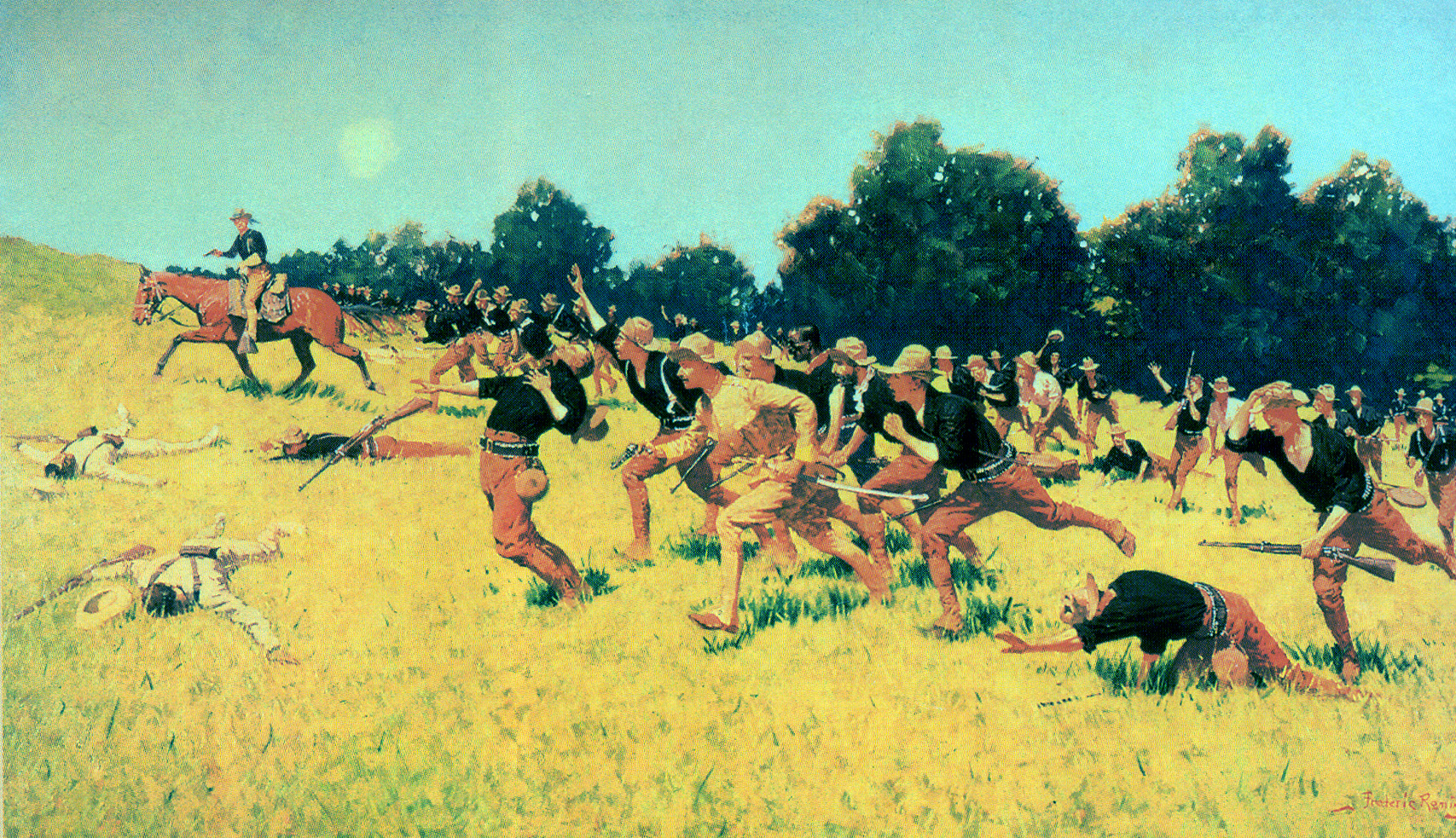
 At this point I tried to see if I could attach metaphors to the experience of being in some of my colleagues' classes. (You can do this with your own as well, but it is easier to ask your own students. What you discover will surprise and amaze you, I guarantee.) There was one history teacher who taught class like Teddy Roosevelt going up San Juan Hill in Cuba during the Spanish- American war. There was an assembling of the troops, a pep talk about mission and purpose, an exhortation about attitude--and then, a full scale, high energy half an hour frontal charge at the topic where some of the troops fell by the wayside on the way up and were left for dead. But the ones who made it to the top were delirious, much more alive than they had felt forty minutes before.

Or the English teacher whose class was like playing the old 1960's Milton Bradely game of Operation. In that game you get a pair of tweezers and you have to remove the "Adam's apple" or the "wrenched ankle" or the "Charlie horse" from a cavity in the board (there were lots of metaphors in this game). The patients parts, however, were electrified so if you were quite dexterous and had well developed small motor skills you were rewarded with money for removing the infected part. But if you were not and your tweezers hit the side of the electrified opening, then a buzzer sounded and you lost your turn. The class was, truly, electrifying.


At about this time a book emerged by George Lakoff and Mark Johnson entitled Metaphors We Live By, and I started to teach a course whose "final exam" was the creation of a set of metaphors that represented the embedded foundation upon which each individual actually based their world-view. Lakoff and Johnson were interested in the broad sweeps of figuring out what was valued by a society by looking at their metaphors. (For example, "Time is money" - a very rich metaphor to mine! If "mining" is in fact, the metaphor you want to use for. You come to realize that metaphor is everywhere once you start listening carefully.)

Ultimately, this deeper awareness and exploration of metaphor can be a foundational cognitive skill for transmitting a larger life skill that can't be taught in traditional ways: empathy.
(to be further discussed).

Sunday, February 24, 2013

The Third Thing: How do we Tell the Dancer from the Dance?

William Butler Yeats wrote on of my favorite poems titled, probably appropriately, "Among School Children." Yeats' meditation ends with the following lines,

"O body swayed to music, O brightening glance,
How can we tell the dancer from the dance?"

I always love the fact that Yeats wrote this after walking through a Montessori school in Dublin and while he is obviously ruminating on life at sixty years old (this poem is particularly poignant and inspiring for me as I have just turned sixty myself), I think he hits upon a fundamental truth about creativity in those last lines. There is a unity between the dancer and the dance that provokes an inseparable oneness. When is what we are watching "the dancer" and when is what we are watching "the dance" becomes impossible to tell.

And in the last month we have had three authorship seminars at CITYterm that have led me to ponder how that that oneness occurs, and perhaps how we can create it ourselves.

Three weeks ago we had a seminar with writer Amy Waldman, author of the novel The Submission. During the course of the dialogue one student asked about whether there had been any epiphanies that she had experienced during the writing of the book and why she thought they had occurred. Her response was to describe how she had been walking down the street one day and wondering why one particular character was so cliched and ineffective when "it suddenly occurred to me that she needed a sex change! That was the problem, the character told me--she was a man. So Lucy became Sean, and everything began to flow again. I just had to listen to what she was telling me."


Last week we attended a performance of the play, Sleep No More, in a 10,000 square foot theater, five stories high in Chelsea. The play goes on for three hours but no spectator's play is the same because it is constructed as a giant "choose you own adventure story" that takes place in countless rooms of a hotel with characters from the play running from room to room performing different scenes. Which means, on some level, you are no longer just a spectator, you are creating the play yourself because you are making some of the creative choices. In the authorship seminar following Tori Sparks ("Lady Macbeth") was asked a question by a student about how the play changes for her as an actress precisely because she has to respond to choices made by the audience. She replied, "There are times when I am acting but I am also watching the audience do something I have never seen them do before, and I have to decide why they are doing that and how should I respond."

And then the other day the production team of a One Child Born: The Music of Laura Nyro came to give a performance for us. This is a one woman show, but there are eight different characters who make appearances during the performance. In the seminar after the show, Kate, Adrienne and Louis (the singer, director and writer) were asked about how the show had come into being. What became clear as they talked, however, was that the show was still "coming into being." What was most remarkable was that they talked about the show as though it were a living thing--something that had a life of its own and was itself making decisions which way it was going with every performance. They even talked about lines that had emerged just for the performance we had just seen.

What had happened in all of these seminars was that each of the authors, in totally different mediums, had created something that was independent of their control. Amy was creating characters, but they were telling her what to do. Tori had a script, but the audience was helping her enact it. Kate had a musical show but it was morphing with every performance in ways that were not her conscious choice.

Each of them had created what my friend Eder has dubbed, "the third thing." The third thing is the relationship that gets created when the artist both talks to but also listens to, what is being created.

If you do this well enough, you really cannot tell the dancer from the dance because what was once a separate dichotomy has become a synergistic whole. That is what Yeats saw at the end of his life--you cannot tell the dancer from the dance, if that relationship exists.  But, the paradox is that you have to create the "third thing"--the relationship--before you can get that unity.


Last night, as I was mulling these ideas over, the movie that appeared on the screen was Top Hat with Fred Astaire. And there on my TV screen was the literal visual representation of what Yeats was talking about--the dichotomy had become a unity. So, I did a little research on how Fred Astaire developed his dancing technique and his relationship to it.

First, I looked for what Ginger Rodgers might say about working with him. As she described it, "Sometimes he'll think of a new line of dialogue or a new angle for the story ... they never know what time of night he'll call up and start ranting enthusiastically about a fresh idea ... No loafing on the job on an Astaire picture, and no cutting corners."

And then for what Fred Astaire himself said,  "For maybe a couple of days we wouldn't get anywhere—just stand in front of the mirror and fool around... Then suddenly I'd get an idea or one of them would get an idea... So then we'd get started... You might get practically the whole idea of the routine done that day, but then you'd work on it, edit it, scramble it, and so forth. It might take sometimes as long as two, three weeks to get something going."

Often I think that one of the hardest parts of teaching experience-based learning is that have to figure out how to generate and tap into the "third thing." It is not enough to teach just how to dance, you have to figure out how to end in a place where no one can tell the difference between the dancer and the dance.


Sunday, January 27, 2013

When you are up to your ass in alligators...


When my students returned from holiday break there was a palpable pall that seemed to have settled over all of them. As one student put it, "You should just think of it as like the beginning of the year; we have to learn everything all over again." But I wasn't asking them to remember anything, I just wanted them to be playful, to make some guesses about a text we were exploring. Essentially, I wanted them to play the "inference game" and make as many predictions as they could about a text; but they weren't having it. I saw it as a kind of refresher that took a basic skill--generating inferences through divergent thinking--and did it in a non-threatening way.

After a fairly extended discussion where I tried to coax out an explanation for why they were having none of this "so-called game" one student said something that went to the heart of the matter.

"Well, we aren't going to be playful and make guesses because we know what the next question is going to be," someone stated.
"What's that?" I asked.
"'Where did you get that idea from? Where do you see it in the text?'  Show me. Right?" she replied.
"Really? Is that what will happen?" I wondered aloud.
"We aren't going to be playful if we know the next question is going to potentially make us feel stupid and vulnerable. We are passive because we can see what's coming down the road, and it's going to hurt. Don't take it personally--it happens in every class," the student added in a consoling manner.

I wanted them to be playful and practice making guesses based on inferences.  But they had rightly realized that the structure of the game was actually a trap -- that if they played it they would then have to justify their imaginings with a reference to the text. I saw it as an imagination game; they saw it as offer proof for what you think. In other words, there would be a competing commitment of textual verification adding on to this playing with inferences. That is what had happened, I had unwittingly set up two opposing ideas that were in competition. Two ideas that I deeply loved--making inferential guesses on the one hand, and being tight to the text and exploring it in minute detail on the other--were running headlong into each other. My class had become a train wreck, and I was responsible. My intention of having the kids playfully work with their imaginings to get close to the text had the unintended implication of making them feel vulnerable.

I thought back to every sheet that I had seen passed out in the school about the way you could contribute to seminar discussions. They were full of roles that were all about referencing the text; nowhere was there a role like, "makes helpful, playful, intuitive inferences and predictions about a text." Making guesses without any analytic evidence was always a bad idea in this arena; they were right. My eyes flitted up to a ring of signs above the whiteboard suggesting these roles that another teacher had put there as reminders. I was literally surrounded by the evidence.

Bob Kegan, from the Harvard Education School, has written a lot about why people are hesitant to  be adventuresome and try new things, why they don't change. One of the reasons he cites is the idea of the "big assumption." Kegan would describe this as the deeply rooted beliefs about ourselves and the world in which we live. They act kind of like the ego would in Freudian theory--they are a necessary protective device used to keep order. Part of getting people to change, Kegan would say, is getting them to surface and identify what might be competing commitments and act on them. If you can't be brave enough to self-implicate and do that, then you just thrash about and can never affect change in yourself or your surroundings.

We often have big commitments that are all about grand ideas, and any school's mission statement is filled with them:  "encouraging creative habits of mind that induce a passion for life-long learning." And then we have competing commitments to concepts like grades that research has shown to be counter-productive to precisely those values cited in the mission statement. Those competing commitments produce a kind of humorous mixed metaphor at their best and a kind of schizophrenic anxiety at their worst.

As a huge fan of Kegan's, one of the things I have learned is that when my classes are not going well it is often the case that there is a "big assumption" that my students hold that is not allowing them to grow. However, often times I am the cause of their doldrums, their anxiety, their feeling vulnerable and unsafe. When I can unearth the competing commitment, we can then get back to learning.

Here is an example of how competing commitments work in non-academic settings. After all, as John Dewey said, "Education is not about preparation for life; it is life.":


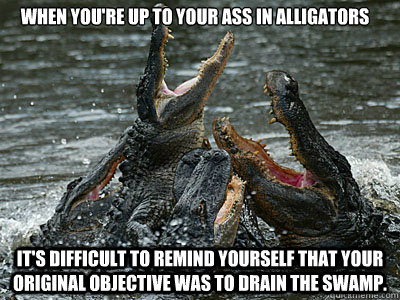
When I was a teenager, my father would post a note (a copy of which is at the head of this blog post) on the refrigerator as a way of communicating to me--first thing in the morning--how I might have "not thought things through as carefully as you might have." The sign said simply, "When you are up to your ass in alligators, it is difficult to remember that your original intention was to drain the swamp."

I clearly remember being a bit confused and flummoxed when I saw the sign for the first time. I had to read it a couple of times to understand and make the application.  I got used to it (I saw it a fair amount some years), but it has come to be a kind of mantra for me when I try to explain the concept of unintended implications.

So, I was up to my ass in alligators again. I think what I have found is that even when you have the best of intentions, you better make sure that swamp doesn't have competing commitments in it.

I had created competing commitments in my class and couldn't see that I was reaping what I had sown--with all the best intentions. I think this is why I have only a little patience with teachers complaining about their students; I want to make sure they have gone through the necessary self-implication.

I saw, in my mind's eye, my father putting the sign on the refrigerator door again. I wonder what it would be like if this were part of a school's mission statement? It is certainly part of the one for my classroom.


Thursday, December 6, 2012

Which of the Kids is doing their own thing?: Patterns and Anomolies

Not long ago the teachers I work with and I had a chance to read Doug Rushkoff's book, Program or be Programmed, and then to ask him questions at one of our monthly Park Cottage sessions where we explore different aspects of how and why learning becomes "deep" or transformative and not simply surface or "strategic." But there remained a foundational central idea that we never really got to, and it has been with me ever since.

Rushkoff's book is structured as "Ten Commands for a Digital Age," but the pivotal concept is the idea that technology itself has bias--"a leaning, a tendency to promote one set of behaviors over another." If you do not acknowledge and understand the bias, you are doomed to be controlled by the medium. As Rushkoff writes, "Only by understanding the biases of the media through which we engage with the world can we differentiate between what we intend, and what the machines we're using intend for us--whether they or their programmers even know it."


Ever since that session, I have been thinking about "school" as the "machine we're using," and trying to discern what its biases are. So, for example, in the blog post about "The Hedgehog and the Fox" (which generated a remarkable amount of interest), I was exploring the idea that we are biased toward (and unaware of it) "hedgehog" learners, and that we have constructed a world that leans toward people who exhibit that trait in schools. Not a bad thing, necessarily, but a bias nonetheless, and a bias that we might want to re-evaluate in view of how many "foxes" we have as learners.

Right now, I am wondering whether there is another "bias" that we have--we are much more inclined to favor patterns in student's thinking over anomalies. And, furthermore, we favor students who exhibit pattern recognition over those who are inclined toward identification of anomalies.

I am thinking about this, in part, because I am presently teaching someone who is one of the most adroit anomaly identifiers I have come across in recent years. For example, when we are reading a short story she immediately spots the place in the text that does not fit the pattern that has been established. However, she does not do it by seeing the pattern and then noting something is happening outside it.

Look at this video, and then let's talk about what you saw.

I actually remember sitting with my children and watching this segment of the show when it would come on and really loving it. But, notice the bias. It is called "Three of these Kids" and then after identifying how the three kids playing baseball form a pattern, only then do we establish which of these kids is "doing his own thing." My student, however, would be the person who not only would not identify the pattern first and THEN go to the anomalous football player, she would just possibly identify that one of the kids is left-handed (the upper left) and all the others are right handed. She is also extraordinarily good at making predictions when it comes to guessing what will come next based on what has come before. I cannot tell, however, if this is because of her skill with anomalies or because she also happens to work intuitively as well.


This has caused me to start to monitor how many times I ask questions that are patterned-based rather than anomaly-based. How often do I work inductively where I start with observations of data, record them and then look for patterns? How often do I ask questions about a text that are really about connecting different passages because I am trying to establish a pattern that I think will promote understanding? And it will promote understanding! But, I think I need to take a tip from Doug Rushkoff and be aware of the bias that I have--and I think most of us have--toward pattern recognition. How does that affect the way we run our classes? How does it affect the way we create tests and other forms of assessments? I am not saying we should stop teaching pattern recognition, only that it would be good to notice that we have that cognitive and epistemological bias (just as we favor analysis over intuition) and that it may give us a clue about some kids who are "doing their own thing" in our classrooms.

Sunday, December 2, 2012

Flannery O'Connor and Andre DuBus: Two Parables about Writing and Reading

We have been reading the manuscript of Mira Jacob's (remember this name, she has a great book coming out) new novel that was just purchased by Random House, and getting ready for our last authorship seminar of the semester. By this point in the semester we have established that there are, at minimum, three acts of "authorship" happening when someone is reading any text.

It is when students are reading in all three of these ways simultaneously that it creates a different kind of relationship to the text--one that is more transformational and life-changing.

The first is that we are reading what the writer wrote and looking at the craft--the conscious choices that any writer makes in practicing their talent--through an analytic lens. In this sense, we are using all the close reading techniques we have practiced and trying not to "dead frog" the text (click to earlier blog post for an explanation). We are also practicing our intuitive reading (more on this is an upcoming blog post) and making some predictions and guesses about what the author's need might be in writing this piece. What is it that the writer set out to explore, and how can you discern that need from the text they created?

And we have realized that there is a way in which the writer is "listening" to the story they are telling and are not in complete control of what is being written. In other words, that there is an "unconscious" quality to writing that happens, and that sometimes it seems to the writer like the story has a life of its own and the writer is almost transcribing what they hear the characters saying. And we have practiced that kind of "deep listening" with Lee Stringer (click to earlier blog post for an explanation). This idea of the story being "alive" was something I never really truly understood until I was teaching Native American students in Albuquerque decades ago. For them, in a way that I had never been exposed to before, some stories were sacred because they created something in their actual telling. In a sense, these stories had their own "authorship" independent of the writer or the reader.

Finally, we have realized that "to read a book is to author it," and that has created an awesome sense of responsibility and a commitment to a dialogic relationship with the text. This is probably the most revolutionary idea for most students. They are so used to being taught that authors are in complete control of their writing, and that everything has an symbolic intention that they forget what Paul Auster said to us once in an earlier authorship seminar, "reading is the only place where two strangers can meet so immediately and so intimately. Together the reader and the writer come together to make the book. I don't think of what I write as a book; it's a text. What I call a book is created when the reader and writer meet in the text."

 
Or, as novelist Danzy Senna put it in our seminar with her, “Once I have said what I have to say, then it is not as if I own the text anymore; the meaning becomes a joint venture (between the writer and the reader).”

This reminds me of two parables that relate to the act of reading and writing. One comes from my friend Buddy who relates the scene at a reading by Flannery O'Connor at UNC. O'Connor had finished her reading and was taking questions when one student posed what is perhaps one of the ultimate "graduate school" questions:

"Ms. O'Connor, I was wondering if I could ask you about the the symbol of the marble cake in your story 'Everything Rises Must Converge?' I was wondering if the swirling of the black and white parts of the cake that lightly touch each other but also remain distinct and separate, that were distinct in their own right, yet each partaking of the other as each of those colors do, acting as a kind of complimentary yet contiguous entity, forcing each to form boundaries yet not being able to ultimately exist without the other in order to form a whole, whether that was a commentary on black/white relations in the South, and that was what you were trying symbolize with that cake."


To which Flannery looked down and said, "Actually, my mother used to make marble cake; and it was always my favorite."

The second story is from a time when Andre Dubus came to visit the English department of the school where I first started teaching. The English department had read a story of his and there was a character, Anna, who did this very out of character (it seemed) action at the end of the story. As I recall, I think she robbed a grocery store.
 
My friend Frank, a hard core analyst of the highest order, opens the discussion with the following question after laying out his understanding of Anna's character prior to this action using copious textual references,

"So, Mr. Dubus, it kind of surprised me when she robbed the store at the end."

"That surprised you too, eh?" replies Dubus.

"What?" answers Frank.

"That surprised you, too, that she robbed the store?"

"Wait, what are you saying? You WROTE the story."

"Well, what are YOU saying, you READ the story. I was just listening, and she said she was going to rob the store."

And what ensued was a conflict about reading and writing that split the department concerning the act of reading between the "pro-Frank" and the "pro-Andre" teachers for the rest of the time I was there.

Now, I look back at them as two fabulous parables about teaching and learning.